
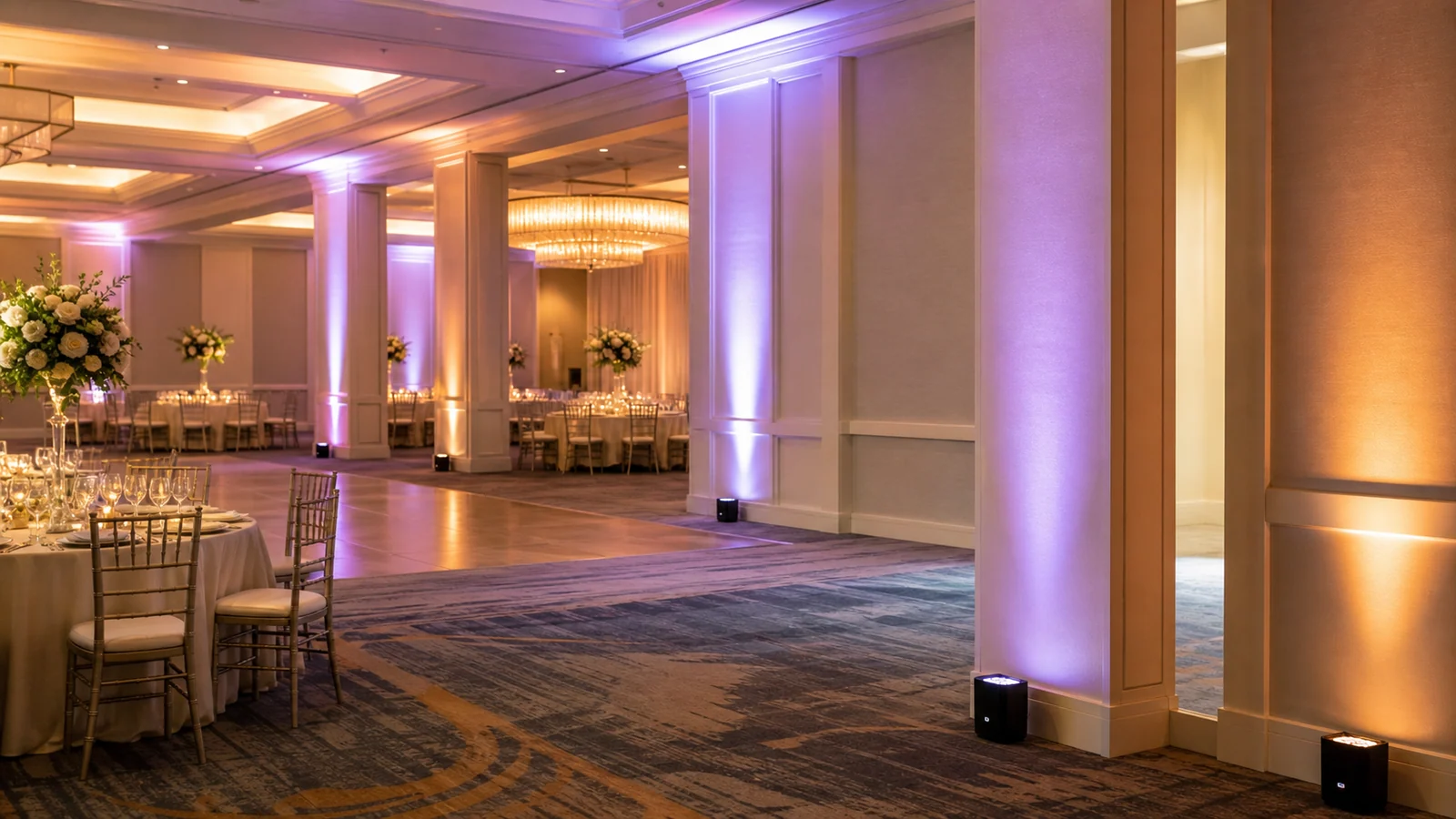
An event team may need uplights around walls, columns, stage edges, entrances, and an entire ballroom perimeter. With conventional fixtures, every position can add another search for an outlet, another power lead to route, and another cable to secure. Battery powered uplights reduce that on-site power wiring and let crews place fixtures more freely, which can simplify both setup and pack-down. They do not remove every cable or planning task, but they can remove a large part of the repetitive power-distribution work from a temporary lighting layout.
The practical value is a lighting plan less dependent on wall sockets. Teams can focus on the surfaces they want to light while still planning runtime, charging, control, public access, and backup power.
Why Traditional Uplighting Can Slow Down Event Setup
Traditional wired uplighting can work reliably, but temporary installation takes time because power must reach every fixture safely. Before focusing a light, a technician may need to locate outlets, check circuit allocation, select extension leads, and plan a safe route.
The work increases with fixture count. Cables may need to avoid doors, service areas, guest paths, drape, staging, and furniture. An approved securing method may be needed where a lead cannot remain outside traffic areas. During strike, crews must disconnect, inspect, coil, and repack those leads.
Power access can also influence creative decisions. A column, alcove, entrance, or temporary scenic surface may be ideal for light but awkward to reach from an outlet. A safe distribution route solves the problem, yet adds equipment and labor for a single accent position.
Battery operation does not eliminate all cables. Charging happens before or between events, controllers may still require power, and some projects need wired data or backup supplies. The advantage is fewer power leads around the venue during the event.
How Battery Powered Uplights Simplify Installation
Battery powered uplights separate placement from nearby power outlets, allowing more work to happen during preparation instead of across the venue floor.
Faster Fixture Placement
Without a power lead at every position, a technician can unload, place, aim, and test fixtures in a direct sequence. This helps when several rooms or event zones must be completed during a short access window. Actual time savings depend on layout, fixture count, control, and local safety requirements, so teams should run their own setup test.
Less Cable Clutter
Reducing power leads creates a cleaner perimeter around banquet rooms, wedding décor, stage edges, and arrival areas. Guest routes still need a site-specific safety review, but a cordless uplight layout gives the crew fewer cable paths to manage.
More Flexible Lighting Positions
Rechargeable uplights can follow walls, columns, scenic elements, and focal points rather than nearby outlets. They suit tent edges, temporary backdrops, and architectural details where power access is limited. Placement must still respect stable footing, public access, weather, ventilation, and approved operating positions.
Faster Strike and Pack-Down
During strike, the crew can collect fixtures without recovering a separate power lead from every location. Chargers, cases, controllers, and remaining cables still need to be packed, but less distribution equipment is spread around the room.
Where Battery Powered Uplights Are Most Useful
Battery powered event lighting is most useful where the layout is temporary, access time is limited, or the desired positions do not align with available outlets.
Weddings and receptions: Battery powered uplights for weddings can follow columns, drape, head-table backgrounds, entrances, and room perimeters without making décor decisions around wall sockets.
Ballrooms and hotels: Battery operated uplights can be repositioned during tight changeovers when a partition, stage, buffet, or seating plan changes, provided runtime and charging are confirmed.
Corporate events: Cordless uplights reduce temporary power distribution around registration areas, scenic elements, presentation stages, and networking zones.
Rental and AV productions: Battery uplights for event rentals can be packaged by room or zone, then deployed as a repeatable system. Rental operations still need battery checks, charging records, spares, and service procedures.
Temporary stages and pop-up events: A battery fixture can cover an accent position that would otherwise need an extension lead. It should not replace a full power plan for continuous high-output lighting.
Theme parks: Weather-rated battery uplights can reduce long power runs to attractions, pathways, façades, and landscape features. Exposed positions require a verified environmental rating and suitable operating instructions. Review the IP65 and indoor battery uplight guide.
Architectural accent lighting: Portable fixtures can highlight columns, arches, façades, and temporary installations. Beam, output, runtime, weather exposure, and public access must still fit the project.
What to Check Before Choosing Battery Powered Uplights
Evaluate the fixture, charger, control method, transport system, and event schedule as one operating system.
Battery Runtime
Runtime should be matched to the programmed output and the complete event schedule. Full output, a single color, mixed colors, dimmed scenes, and effects can place different loads on a battery. Ask which channels and intensity were used for a published figure, how the end point was defined, and whether the test reflects the scene you intend to run.
Include setup, guest arrival, performance, schedule overruns, and strike preparation in the operating window. Battery age and temperature may affect capacity. Plan a reserve instead of treating an advertised duration as the exact usable event time.
Charging and Fleet Management
Charging must fit the turnaround between jobs. Compare verified charging time, connector arrangement, battery-status display, case capacity, and simultaneous charging capacity. Confirm the electrical input and procedure for any charging case.
Number fixtures and record their state before dispatch and after return. Each unit needs a known charge state, a working charger path, and a response plan if it fails to charge.
Light Output and Color Quality
Judge output on the intended wall, throw distance, ambient light, and color. A fixture may look different on light paint, dark brick, textured stone, drape, or a daylight-exposed surface. Compare verified photometrics where available, then test a sample.
For repeatable fleets, evaluate saturated colors, pastels, white appearance, low-level dimming, and consistency between units. Nominal LED wattage alone does not predict the result on the wall.
Beam Angle
Beam angle changes the height and width of a wash. A narrower beam can create a concentrated column; a wider beam can produce broader overlap at a shorter distance. Choose using wall height, spacing, fixture distance, architecture, and the desired rhythm.
Use the verified optics for the selected model when planning quantity. The professional uplight spacing guide explains how perimeter, spacing, ambient light, and spares work together.
Indoor and Outdoor Protection
Rechargeable uplights are not automatically outdoor fixtures. For exposed work, check the exact IP rating, connector-cover conditions, mounting position, operating temperature, and charging restrictions. Chargers and cases may have different limits.
LumiUp publishes the Aqua P12 as a rechargeable 12 × 18W IP65 battery PAR platform for theme parks and temporary architecture. Confirm project-specific runtime, control, and charging details. Indoor work can be considered against the LumiUp Core P6 battery LED PAR, while exposed projects can start with the LumiUp Aqua P12 platform.
Wireless Control
“Wireless uplights” is often used loosely. Battery operation and wireless DMX are separate capabilities. Confirm whether the fixture supports the required protocol, controller, DMX modes, and appropriate behavior after signal loss.
Walls, people, staging, other radio systems, and antenna placement can affect control. Test wireless DMX uplights in representative conditions and prepare an appropriate fallback look or control method.
Housing and Transport
A portable fixture must survive repeated handling. Review housing, feet and brackets, connector protection, weight, stackability, case fit, and inspection access.
Transport design should organize fixtures, chargers, controllers, and documentation, and reveal missing or quarantined units before the next event.
Wired vs. Battery Powered Uplights
Battery fixtures favor rapid temporary deployment and flexible positioning; wired fixtures can suit convenient power and uninterrupted operation.
| Decision factor | Wired uplights | Battery powered uplights |
|---|---|---|
| Setup time | Includes routing and securing power for each position | Can reduce on-site power-distribution work |
| Power cable requirements | Power lead required during operation | No operating power lead at each fixture; charging still required |
| Placement flexibility | Influenced by outlets and cable routes | Less dependent on nearby outlets |
| Long-duration operation | Well suited when stable power is available | Depends on verified runtime and operating mode |
| Outdoor availability | Depends on the exact fixture rating and connection method | Depends on the exact fixture rating, connector state, and instructions |
| Charging requirements | No battery charging workflow | Requires planned charging, status checks, and turnaround |
| Typical scenarios | Fixed positions, very long operation, convenient power | Weddings, rentals, pop-ups, temporary accents, difficult power access |
A mixed approach is often reasonable. Wired lights can cover fixed or long-duration positions, while wireless battery uplights handle areas where a cleaner temporary layout or flexible placement adds value.
A Practical Setup Checklist for Event Teams
Use a repeatable checklist for uplighting for events:
- Fully charge every fixture using its approved charging method.
- Estimate runtime from event duration, output level, color mode, setup time, and a practical reserve.
- Number fixtures and match them to cases, rooms, or lighting zones.
- Set and record wireless pairing, DMX addresses, or standalone programs before arrival when possible.
- Confirm environmental protection and connector requirements for every outdoor position.
- Pack a suitable number of spare fixtures or an approved backup-power option.
- Test the complete control path in a representative layout.
- After the event, record remaining battery status, faults, physical damage, and charging progress.
When Battery Powered Uplights May Not Be the Right Choice
Battery fixtures may not be the right primary tool when the operating period exceeds verified runtime, centralized charging cannot be arranged, or the application needs sustained output the selected configuration cannot maintain. A wired system may be simpler for permanent positions with reliable power.
Complex radio environments can reduce wireless-control convenience. Multi-day use also needs a realistic recharge and rotation plan. Let the schedule and site conditions guide the decision.
Why LumiUp Focuses on Practical Event Lighting
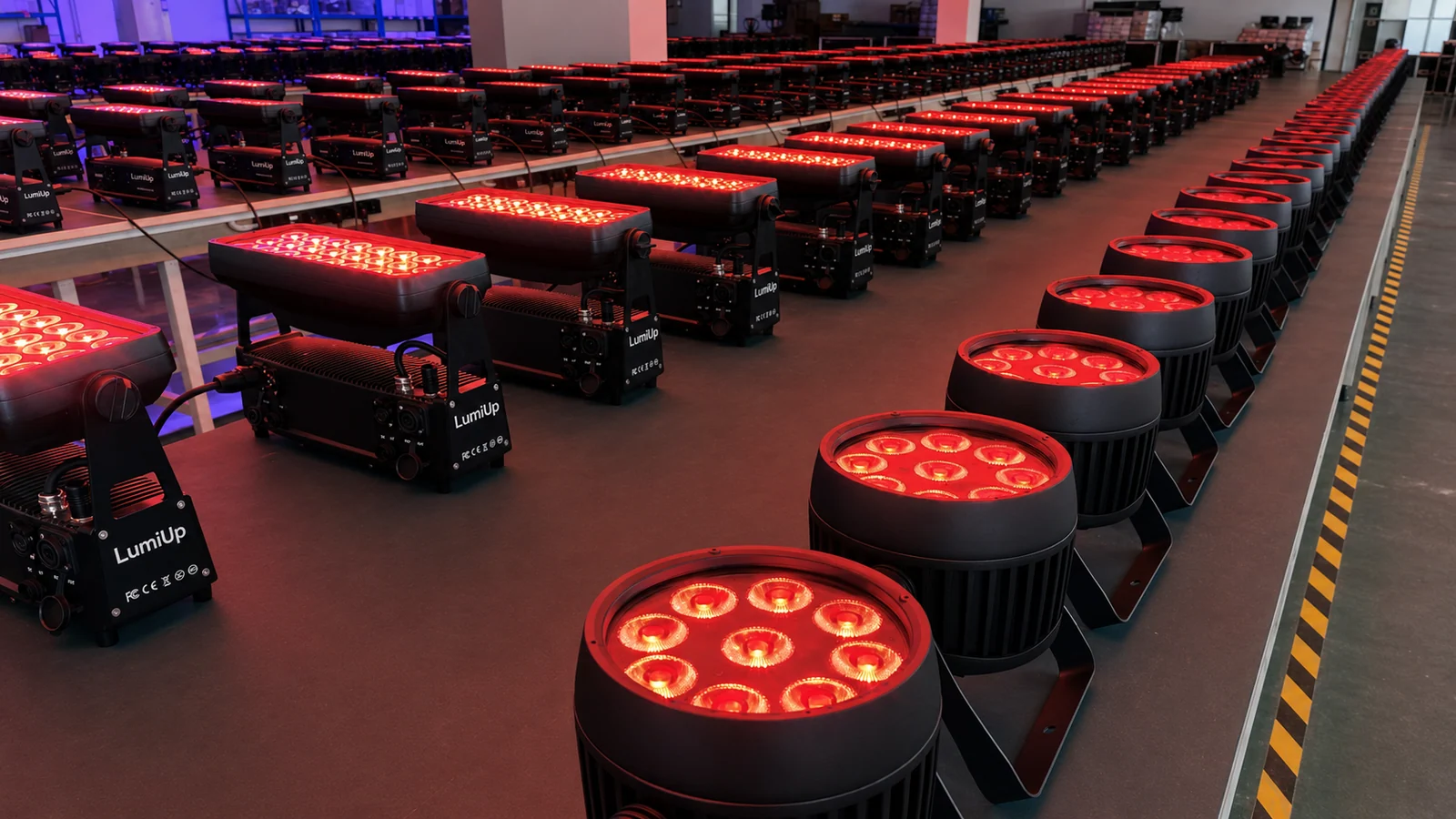
LumiUp develops professional battery-powered LED lighting for portable event, rental, stage, and temporary architectural applications. The published range includes battery PAR formats, an IP65 outdoor PAR platform, a linear wall washer, and a battery LED panel.
LumiUp emphasizes focused product development, consistent production, quality control, and responsive technical support. Specific runtime, charging, optical, and wireless-control claims are confirmed against the selected product configuration rather than generalized across the range. Event teams can browse the current battery-powered lighting products or provide their venue, quantity, runtime, control, and environmental requirements for a more focused discussion.
Frequently Asked Questions
How long do battery powered uplights last?
Runtime depends on the exact fixture, battery condition, brightness, active colors, programmed effects, temperature, and operating mode. Compare figures only when the test conditions are stated. Include setup and schedule overrun in the required window, then keep a practical reserve. Use model-level runtime data with stated conditions; a single-color or dimmed result does not represent full-output operation.
Are battery powered uplights bright enough for weddings?
They can be suitable for many wedding and reception layouts, but brightness must be evaluated against wall height, surface color, fixture distance, beam angle, ambient light, and the intended effect. A compact room accent and a tall ballroom wall require different output. Test the proposed fixture and spacing on a representative surface before fixing the package quantity.
Can battery powered uplights be used outdoors?
Only models with a verified environmental rating and suitable operating instructions should be used in exposed conditions. Check the exact IP rating, connector covers, mounting position, temperature limits, charging restrictions, and expected weather. Battery operation alone does not make a fixture weather-resistant, and the charger or charging case may not share the fixture's protection.
Do battery powered uplights need DMX cables?
Not always, but battery power does not automatically mean wireless control. Some fixtures can run standalone, some support a compatible wireless-control option, and others may use wired DMX. Confirm the exact protocol, transmitter requirements, DMX modes, signal-loss behavior, and venue conditions. Even a wireless lighting system may still need powered control equipment elsewhere in the setup.
How many battery uplights do I need for an event?
Quantity depends on the illuminated wall length, spacing, wall height, beam angle, output, surface color, ambient light, and desired visual rhythm. Count focal points separately and include appropriate operational spares. A representative layout test is more reliable than a universal fixtures-per-guest rule. Use measured perimeter and verified optics as the starting point.
Are battery powered uplights better than wired uplights?
They are more convenient when rapid temporary setup, reduced cable clutter, or placement away from outlets matters. Wired uplights may be more practical for very long operation, permanent positions, sustained output, or venues with convenient power. Many productions benefit from using each format where its operating strengths match the job instead of choosing one for every position.
What should rental companies check before purchasing battery uplights?
Review runtime test conditions, charging time, simultaneous charging capacity, battery-status indication, control compatibility, output, color consistency, optics, housing, cases, service access, spares, and verified outdoor protection where required. Test a sample in a representative venue and document the acceptance criteria. Fleet readiness depends on charging and maintenance workflow as much as fixture count.
Conclusion
Battery powered uplights address three common temporary-event problems: time spent distributing power, visible cable clutter, and lighting positions constrained by nearby outlets. They can make weddings, ballrooms, rental productions, outdoor zones, and temporary architecture easier to plan when runtime, charging, output, control, transport, and environmental limits are evaluated together.
Explore the LumiUp battery-powered lighting range to compare available fixture formats. For a project-specific recommendation or quotation, contact LumiUp with the venue, fixture quantity, required operating time, control method, and application.