
Quick Answer
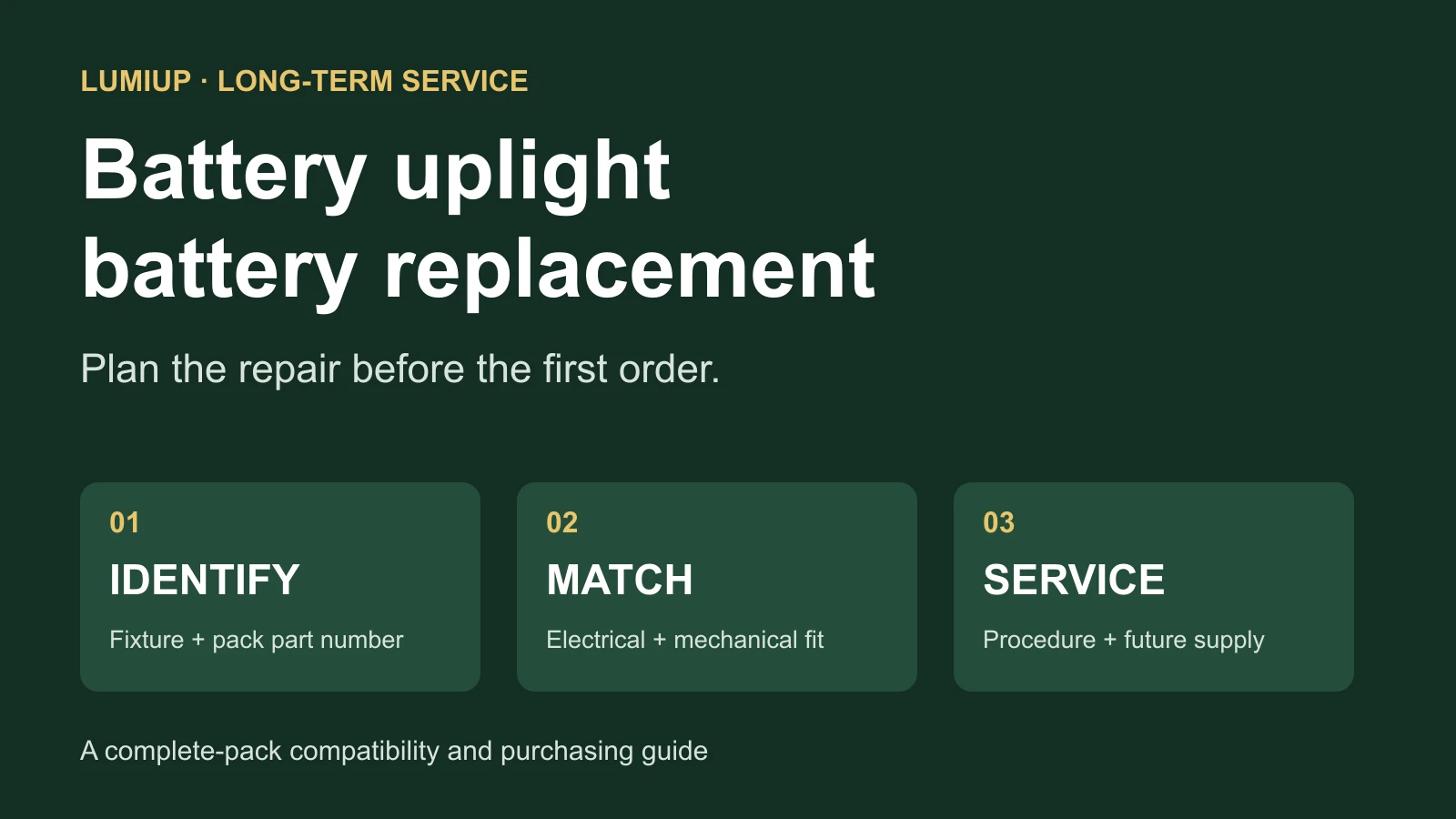
Before buying a fleet, ask the manufacturer whether each model's battery can be replaced, who may do the work and which complete battery pack fits your production version. Obtain the approved pack part number, electrical and mechanical specifications, charging requirements and service procedure, together with a current price and supply arrangement. Keep that information with the original order. A matching mAh figure or connector shape is insufficient: a replacement must work with the fixture's electronics, protection and enclosure.
Establish Who Can Replace the Battery
Battery aging does not necessarily mean retiring a fixture. However, the repair route depends on how that model was designed and what the manufacturer authorizes. Ask about eventual replacement before placing the bulk order, when the supplier can tie its answer to the exact configuration being purchased.
An internal battery may require an authorized technician to open the housing and complete the prescribed checks. A user-replaceable battery has a documented procedure permitting the owner or trained crew to install an approved assembly. A quick-change system is designed for repeated exchanges between runs. These arrangements have different labor, equipment and downtime costs.
Neither “replaceable” nor “removable” establishes permission to exchange a battery while the light is operating. Hot swapping needs explicit support from the manufacturer. For event-to-event rotation and spare-pack planning, use the swappable battery uplight buying guide. Here, the decision is whether an aging pack can be replaced through a supported service route.
Start With Fixture Identity and a Complete Pack Part Number
Give the supplier the fixture model, serial number or production batch, hardware revision if assigned, and original order reference. Two fixtures sold under the same name may have different connectors, charging arrangements or service parts after a production change.
Request a complete replacement battery pack part number and a written list of supported models and revisions. Record the identification label and specification revision beside it. A description such as “battery for our outdoor PAR” is difficult to use when ordering several years later, especially if the contact person has changed.
Define what the assembly includes: cells, protection board, insulation, wiring, connector, enclosure and dedicated retention hardware where applicable. If seals or fasteners are supplied separately, identify those parts too. An inexpensive cell-only quotation and a ready-to-install assembly are different purchases. Save the approved specification, photographs and quotation together so the next buyer can reproduce the order.
Replacement Battery Pack Purchasing Checklist
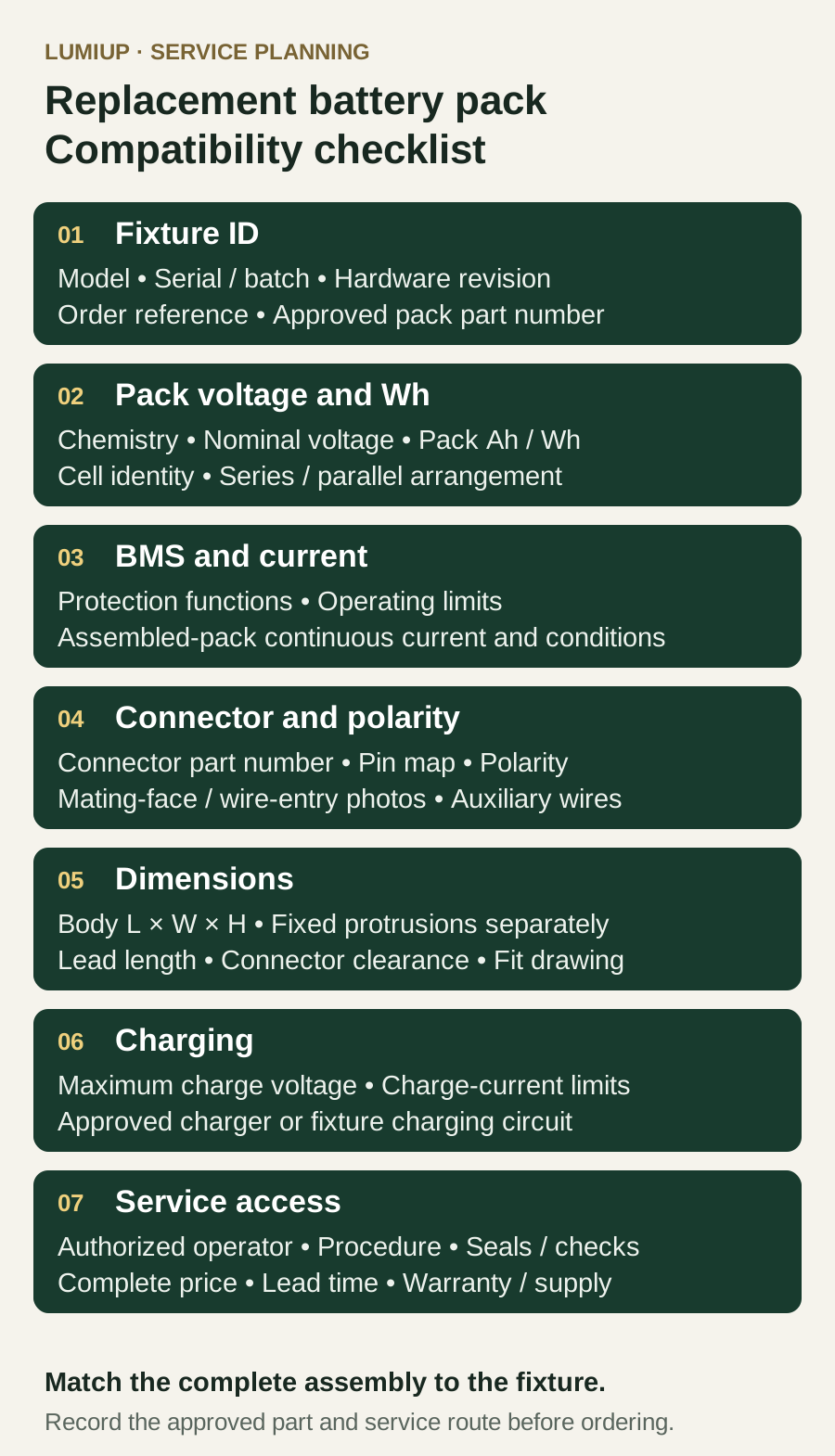
Ask your supplier to complete this checklist for the exact replacement pack and fixture version.
Swipe horizontally to compare the purchasing fields.
| Item | Information to request | Purchase decision it supports |
|---|---|---|
| Fixture and pack identity | Fixture model, serial/batch, hardware revision, original order, complete pack part number and supported revisions | Orders the correct service assembly |
| Chemistry and energy | Chemistry, nominal pack voltage, pack mAh/Ah and Wh | Establishes the electrical starting point |
| Cell arrangement | Series/parallel notation and total cell count | Distinguishes pack design from individual-cell ratings |
| Cell specification | Format, manufacturer, cell model and individual-cell capacity | Makes component identity traceable |
| Revision and substitution | Approved replacement when cells or pack versions change; compatibility range | Prevents an undocumented substitution |
| Protection system | BMS/protection-board identity, protection functions and operating limits | Defines protection rather than a generic “BMS included” label |
| Continuous discharge | Maximum continuous current for the assembled pack, temperature and other rating conditions; peak current separately | Checks the pack against the fixture load |
| Connector and auxiliary wires | Manufacturer, series, part number, pin map, polarity and sensing/identification/communication functions | Matches the complete electrical interface |
| Mechanical fit | Pack body L × W × H; fixed protrusions, lead length, exit direction and connector clearance recorded separately; dimensioned drawing, mounting and retention | Confirms the pack can be installed correctly |
| Charging | Maximum charge voltage, recommended and maximum charge current, approved charger or charging circuit | Preserves compatibility with the charging system |
| Replacement procedure | Authorized operator, tools, seals, fasteners and required checks after replacement | Prices the complete return-to-service process |
| Commercial support | Complete-pack price, quotation validity, lead time, minimum quantity, supply arrangement and warranty scope | Makes future service cost and availability assessable |
A signed configuration sheet is easier to use than scattered chat replies. Ask the supplier to explain discrepancies between the label, quotation and specification before approving the spare. Record the pack body’s L × W × H, any fixed protrusions, lead length and connector clearance separately. Use a dimensioned drawing to check the space required for installation.
Read Voltage, Ah and Wh Together
Nominal pack voltage and charge capacity describe different properties. Convert milliamp-hours to amp-hours before calculating nominal energy:
Ah = mAh ÷ 1,000
Wh = nominal pack voltage × pack Ah
The FAA's lithium-battery guidance explains the voltage-times-Ah calculation. A capacity number without voltage does not establish Wh. Use the supplier's nominal pack rating, not its maximum charging voltage, in this calculation.
Separate the capacity of one cell from the capacity of the assembled pack. Series connections raise voltage; parallel connections raise capacity when matching cells are combined. Victron's battery-bank explanation describes that distinction. For example, 3S4P describes three series-connected groups of four parallel cells, making 12 cells in total. Confirm the arrangement for your fixture on its battery specification sheet.
A larger Ah value does not establish fit, current capability or charging compatibility. Nor does calculated Wh guarantee event runtime: usable energy and the fixture's actual load still matter. The uplight runtime guide covers those operating conditions in detail.
Match Protection, Current and the Original Electronics
“Contains a BMS” leaves several questions unanswered. Request the board or assembly identity and its functions, including the applicable charge/discharge voltage limits, overcurrent and short-circuit protection, temperature monitoring and balancing where fitted. Texas Instruments' battery-protector overview illustrates how protection functions differ between designs.
The current rating must apply to the assembled pack under stated conditions. A cell's discharge rating, a component rating on the protection board or a brief peak value cannot substitute for continuous pack capability. Cells, protection circuitry, wiring, connections and thermal conditions all affect the assembly. Ask which operating conditions the supplier used to establish the continuous rating.
Compatibility extends into the fixture. The replacement must match the original LED driver, charging circuit and any temperature, identification or communication functions. The CPSC's battery-system guidance recommends assessing cells, packs, chargers and the end product together. A different pack that requires electronic changes needs a manufacturer-defined service solution, with its parts and checks documented. It is not a buyer-side connector or BMS modification job.
Confirm Connector Orientation and Mechanical Fit
A connector that fits physically can still have a different pin assignment or polarity. Adafruit's charger connection guidance gives a concrete example of reversed polarity damaging charging equipment. Match the specified connector and pin map rather than treating housing shape or wire color as proof.
Request a legible photograph of the real pack label, a close view of the connector's mating face and a view of its wire-entry side. The photographs should show orientation, latch and identifying marks. Match them to the connector manufacturer's series and part number. Additional wires may carry temperature sensing, identification or communication; obtain their documented functions before selecting a substitute.
Check the pack body dimensions and fixed protrusions against the battery compartment, using a dimensioned drawing. Confirm lead length and exit direction separately. Include room for the connector to mate and for wiring to follow the approved route without pinching. Retention, insulation and protective covers belong in the compatibility check alongside electrical ratings.
Include Charging and Enclosure Service in the Plan
The maximum charge voltage and recommended current must belong to the exact battery and approved charging system. Obtain the maximum permitted charge current separately. Charger appearance or a familiar plug does not establish suitability. Identify whether the service replacement uses the fixture's existing charger, internal charging circuit or an approved separate unit.
If the quotation states a 0–100% charging time, record the starting and ending criteria, charging equipment, ambient conditions and whether the light was operating. That makes the number useful without substituting it for the charging specification.
Opening an outdoor fixture may involve gaskets, covers, fasteners or sealed connections. Ask which items are renewed, who performs the work and what inspection or testing is required afterward. Merely closing the cover does not demonstrate that the prescribed enclosure condition has been restored. Include those tasks in the repair cost and turnaround estimate. The battery care guide provides the broader maintenance and storage context.
Price the Complete Repair and Future Supply
Ask for a complete-pack unit price with quotation validity, quantity and destination. Then separate freight, any required seals or accessories, authorized service labor and return transport. The lowest battery price may leave substantial installation or shipping costs outside the quotation.
Record spare-part lead time, minimum order quantity and the supply method: current stock, production to order or an agreed reserve. Ask what happens when the original cells or pack part number are discontinued. A compatible replacement needs a controlled identity and documented revision coverage, rather than a promise that something similar will be available.
Warranty terms should distinguish manufacturing defects from capacity loss in service. Request the battery coverage period, defect criteria, how capacity-related claims are assessed and who pays for parts, labor and freight. Also ask how replacement under the approved procedure affects the remaining fixture warranty. There is no universal battery price, lifespan or supply period that applies to every fleet.
Keep the reply with the purchase file and revisit it before a repeat order. The manufacturer evaluation guide helps place service commitments alongside sample approval and supplier selection.
Apply the Record to Your LumiUp Configuration
The LumiUp Aqua P4RX provides a concrete example of a latch-secured removable battery design. Its published procedure calls for switching off before removal and securely reinstalling the pack before use. Use the replacement instructions and compatible pack part number supplied for your exact model and production version.
For LumiUp Aqua P12 (LU-AQP12), send the model, quantity, destination and requested spare-pack information. If you already own the fixtures, include the order reference or serial/batch number. Ask for the configuration sheet and service route for that order. An mAh figure on its own cannot establish pack voltage, internal construction or who may replace it.
Frequently Asked Questions
Can every battery uplight have its battery replaced?
No. Some have an approved service or user-replacement route; others may require factory work or have no supported replacement option. Obtain the procedure and matching part number for the exact version before buying.
Can I use a replacement battery with the same mAh rating?
Not on that basis alone. Chemistry, voltage, protection, continuous current, connector pinout, dimensions, charging and fixture compatibility must also match the approved specification.
Can a higher-capacity battery extend runtime?
It may provide more usable energy if it is an approved compatible pack. Check fit, protection, charging and the manufacturer's operating limits first, then verify runtime in the intended scene. More mAh alone is insufficient.
Does “replaceable” mean I can change batteries during an event?
It may refer only to workshop service. Routine crew exchange requires an approved procedure, and replacement while operating requires explicit hot-swap support. Plan any required shutdown into the event workflow.
Should I order individual cells or a complete battery pack?
For a documented pack-replacement procedure, order the approved complete assembly. Cell-level rebuilding requires specialist manufacturing and validation; individual cells do not replace the protection, insulation, wiring and mechanical parts of the assembly.
How much does a replacement battery cost?
Obtain a current quotation for the exact complete pack, quantity and destination. Compare the battery price together with accessories, service labor and freight, and record lead time, quotation validity and warranty terms.