
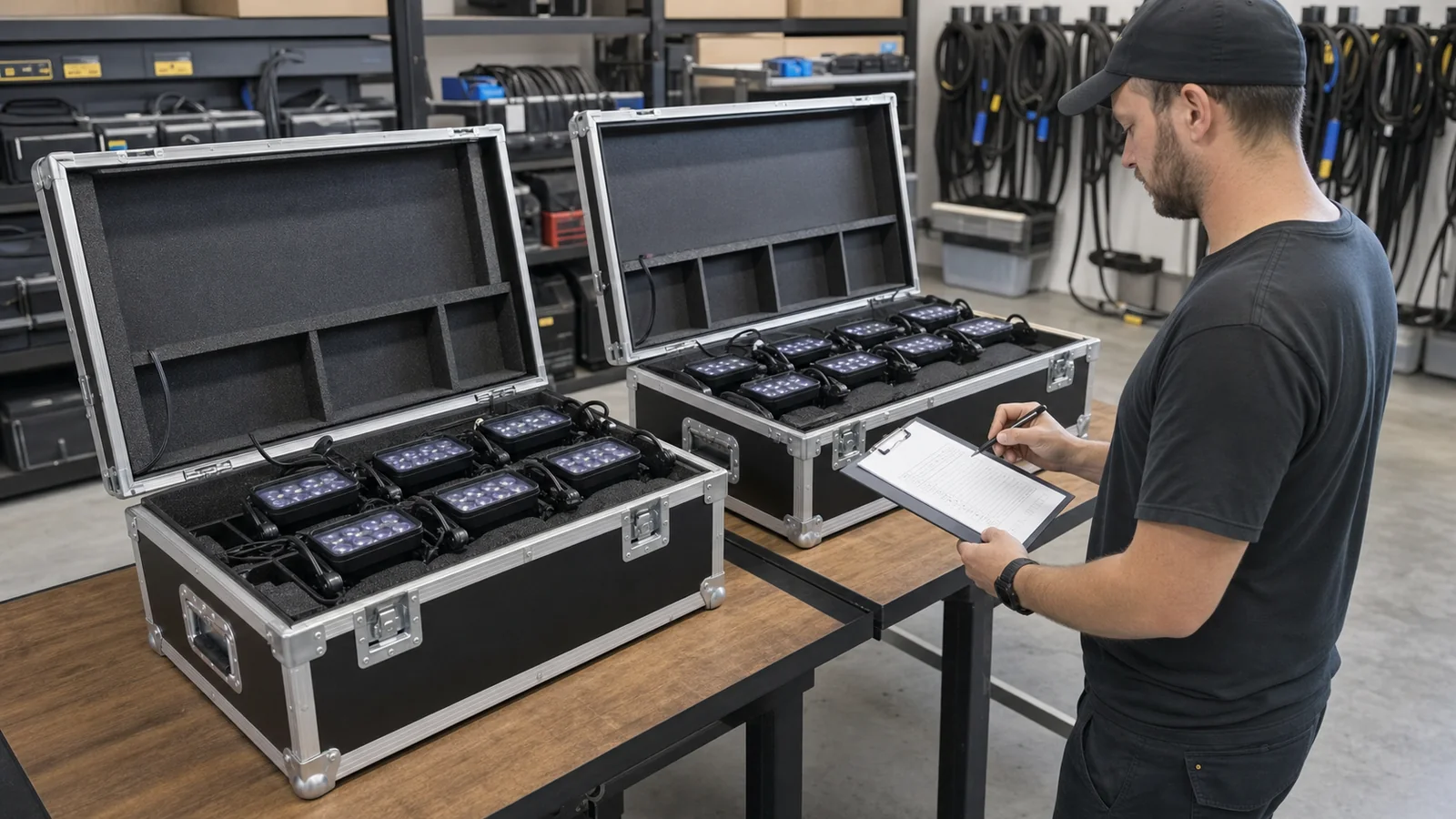
Quick Answer
A three-hour charging claim does not mean a 60-light rental fleet will be ready three hours after it returns. Your real turnaround depends on five things: how many fixtures come back together, how many approved charging positions can operate at the same time, the verified charge time under the quoted configuration, the non-charging work around each batch, and the deadline for the next dispatch.
Start with this conservative planning equation:
Committed fleet turnaround = inbound handling + cool-down/condition time + inspection and staging + (charging batches × verified batch charge time) + full-charge verification + packing + operational reserve
Where:
Charging batches = round up (fixtures requiring charge ÷ simultaneous approved charging positions)
This produces two different answers. Theoretical minimum charging time covers the charging batches only. The time you can responsibly promise to operations also includes unloading, inspection, status checks, repacking and a buffer for exceptions.
Why “Fully Charged in Three Hours” Is Not a Fleet Plan
A published single-fixture charge time is useful, but it answers only one question: how long did one compatible charging setup take under the supplier’s stated conditions?
Some product pages advertise a recharge time of about three hours alongside a maximum runtime that depends on intensity. Those figures can be useful starting points, but they do not tell you how many units your warehouse can charge at once or whether the entire fleet will meet the next dispatch deadline.
Before using any charge or runtime claim in a dispatch schedule, ask:
- What battery state started the charging test?
- Was the fixture switched off, or was it operated while charging?
- What ambient temperature and battery age applied?
- Which approved adapter, dock, pack charger or flight case was used?
- Does the stated time apply to one fixture or every occupied position at once?
- How is “full” indicated and confirmed?
- Was runtime tested with all color channels, one color, an automatic program or a dimmed scene?
- How many fixtures must be ready for the next event, and how many charging positions will be available?
Do not compare one product’s maximum runtime at an unspecified or reduced intensity with another product’s all-channel or full-output runtime. The test modes are different.
Calculate Battery Uplight Fleet Turnaround
Use the following method for each SKU and charging configuration. Do not combine models unless the supplier confirms the same approved charger, timing and operating conditions for all of them.
1. Define the dispatch deadline
Measure the window from warehouse arrival after Event A to the required load-out time for Event B. Do not measure from the end of the first show to the start of the next one. Transport in both directions can consume hours that never reach the charging bench.
2. Count the fixtures that need processing
Record the complete return batch, then separate it into:
- ready without charging;
- charging required;
- service required;
- quarantine due to impact, moisture, unusual heat, damaged contacts, swelling, damaged cables or another abnormal condition.
Only the “charging required” count belongs in the batch calculation. Quarantined equipment is not available capacity.
3. Count approved simultaneous charging positions
A charging position is not simply an empty shelf or socket. It is one manufacturer-approved adapter, dock, pack-charger position or case compartment that can operate under the documented electrical and environmental conditions.
If you own 20 lights but only 10 approved positions can charge at once, a full-return batch requires two charging batches. If a case holds 10 lights but the documentation does not confirm all 10 can charge simultaneously, mark the simultaneous capacity as to be confirmed.
4. Use a verified batch charge time
Use the time for the exact fixture, battery, charger and starting condition you plan to operate. A first-use charge instruction is not automatically the same as a routine full-charge specification. A recommendation such as “charge for at least four hours” is also not a measured zero-to-full guarantee.
Where the supplier has not published a time, request a written test record or run an acceptance test before committing the fleet to back-to-back work.
5. Add the work around charging
Build a simple timeline for the entire batch:
Swipe horizontally to review every workflow stage.
| Workflow stage | What to include |
|---|---|
| Unload and count | Vehicle unload, case opening, asset count and return scan |
| Cool-down and condition check | Time required by the instructions; acclimation after major temperature changes; check for moisture or abnormal heat |
| Exterior inspection | Housing, lens, feet, handles, seals, ports, charging contacts, cables, latches and battery packs |
| Charging setup | Move units to approved positions, connect or seat them, record start status and verify charging indication |
| Batch charging | Number of batches multiplied by the verified time per batch |
| Full-charge confirmation | Check the documented indicator or measurement and isolate exceptions |
| Functional readiness test | Power-on, output, control, addressing/pairing and required accessories |
| Packing and dispatch | Clean, repack, label, load and complete the dispatch record |
| Operational reserve | Allowance for slow units, a failed charger position, staffing delay or a fixture moved to service |
Some work may overlap after your team validates a standard operating procedure. Until then, a conservative sequential timeline is easier to defend than an optimistic schedule that assumes every handoff happens immediately.
Charging Positions and Circuit Capacity Are Different Limits
Twenty physical charging positions are useful only when the available electrical system can power the approved configuration.
For procurement, request the maximum input current or power for every adapter, dock or occupied case, not the fixture’s LED output wattage. Then give the complete charging plan to the person responsible for venue or warehouse electrical safety.
At minimum, confirm:
- input voltage and frequency for the destination market;
- maximum input current or watts per charger, dock or fully occupied case;
- power factor and inrush current where relevant;
- the number of positions allowed to charge simultaneously;
- whether power linking or daisy-chaining is permitted and its limit;
- required protective earth, breaker, RCD/GFCI or other local protection;
- plug type and whether adapters are permitted;
- ventilation clearance and ambient-temperature limits;
- whether the case lid must remain open;
- whether wet, cold or condensation-exposed fixtures must dry or acclimate before charging;
- whether charging in a vehicle, closed case or unattended area is permitted.
If the only available value is watts, dividing total watts by nominal voltage can support an early load estimate. It is not a substitute for the nameplate current, the charger instructions or a qualified electrical review. UK/EU, US and Canadian sites may use different supplies, plugs and protection rules, so keep the final circuit plan market-specific.
Choose a Charging Architecture That Matches the Workflow
Built-in battery with a plug-in charger
An integrated battery keeps each fixture as one asset. It can work well when the fleet has enough approved adapters and charging space for the normal return batch.
The procurement risk is position count. A five-hour single-fixture charge time becomes a 10-hour theoretical charging window when 20 fixtures must pass through 10 positions in two full batches.
The current LumiUp Core P6 page publishes a five-hour charging time for that model. Confirm the supplied charging hardware, simultaneous capacity, circuit load and operating conditions in the quotation and manual before using that figure in a fleet commitment.
The current LumiUp Flex PL18 Pro page publishes a charge time of within eight hours for its 24,000mAh built-in battery. That larger Flex panel is useful as a boundary example: its charging figure belongs to LU-FXPL18X and must not be transferred to Core or Aqua fixtures. The public page does not state charging-case compatibility or multi-unit electrical limits.
Removable battery pack
A removable pack separates fixture readiness from battery charging. A prepared pack can return a fixture to the available pool while the used pack enters a separate charge, inspection and tracking loop.
The LumiUp Aqua P4RX uses a latch-secured removable pack and supports in-fixture or separate pack charging. Its current page publishes an initial charge of four to five hours and recommends at least four hours for routine charging. The current public material does not identify the separate charger, its position count, the included spare-pack quantity or a measured routine zero-to-full time. Treat those items as to be confirmed, not as implied accessories.
Use the removable-battery fleet workflow to plan pack IDs, inspection, seating, latch checks and service stock.
Drop-in contact charging base
A dock can reduce repeated cable handling. The operator seats the compatible fixture on the powered base, and aligned contacts make the charging connection.
The Aqua P9X charging base is a one-fixture contact dock with a 100–240V AC, fuse-protected input. The Aqua P9X page states that the dock is optional and sold separately. It also describes a compatible flight-case configuration with one charger in each compartment, sold separately.
The public pages do not currently publish Aqua P9X charge time, dock input current, simultaneous multi-dock electrical limits or environmental conditions for charging. A dock improves the connection workflow; it does not prove faster battery charging.
See the Aqua P9X contact-charging guide for the difference between physical contact charging, wireless control and battery-powered operation.
Multi-light charging flight case
A charging flight case can combine transport, storage and organized charging. It is valuable when its electrical design and fixture compatibility are documented for the exact fleet.
LumiUp’s current Battery PAR Charging Flight Case page lists 6-, 8- and 10-light configurations. The current public record does not identify a universal compatible-fixture list, input load, charge time, simultaneous-use limit, ventilation requirement or lid position. Request the configured case SKU and written conditions in the quotation. Do not assume that every LumiUp battery light fits or uses the same charging system.
The charging-options guide compares plug-in adapters, cases, docks and removable packs in more detail.
Example 1: 20 Fixtures, 10 Charging Positions
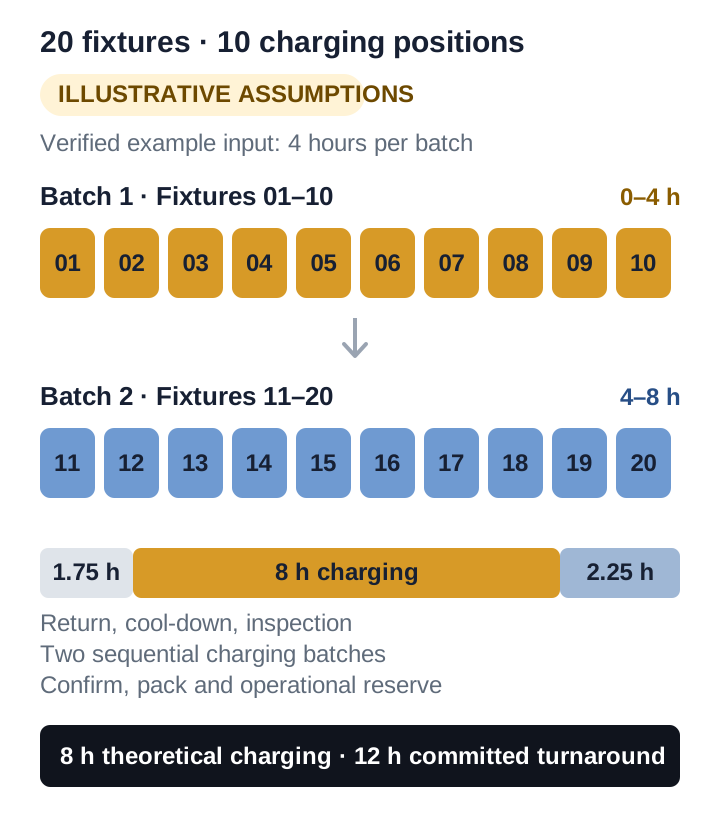
Illustrative assumptions only — not a LumiUp product specification or performance commitment.
Assume 20 returned fixtures all require a full charge, 10 approved positions can charge simultaneously, and the verified batch charge time is four hours. Also assume the following conservative workflow:
- unload and count: 0.5 hour;
- cool-down/condition time: 0.5 hour;
- inspect and stage: 0.75 hour;
- full-charge and function confirmation: 0.5 hour;
- packing and dispatch preparation: 0.75 hour;
- operational reserve: 1 hour.
The calculation is:
- charging batches = round up (20 ÷ 10) = 2 batches;
- theoretical minimum charging time = 2 × 4 hours = 8 hours;
- conservative committed turnaround = 0.5 + 0.5 + 0.75 + 8 + 0.5 + 0.75 + 1 = 12 hours after warehouse arrival.
A 10-hour warehouse-to-dispatch window would not support this conservative commitment. Options include adding approved charging positions, keeping verified ready spares, using an approved removable-pack rotation, or changing the dispatch plan. Do not remove inspection or the operational reserve simply to make the arithmetic fit.
Example 2: 60 Fixtures, 20 vs 30 Charging Positions
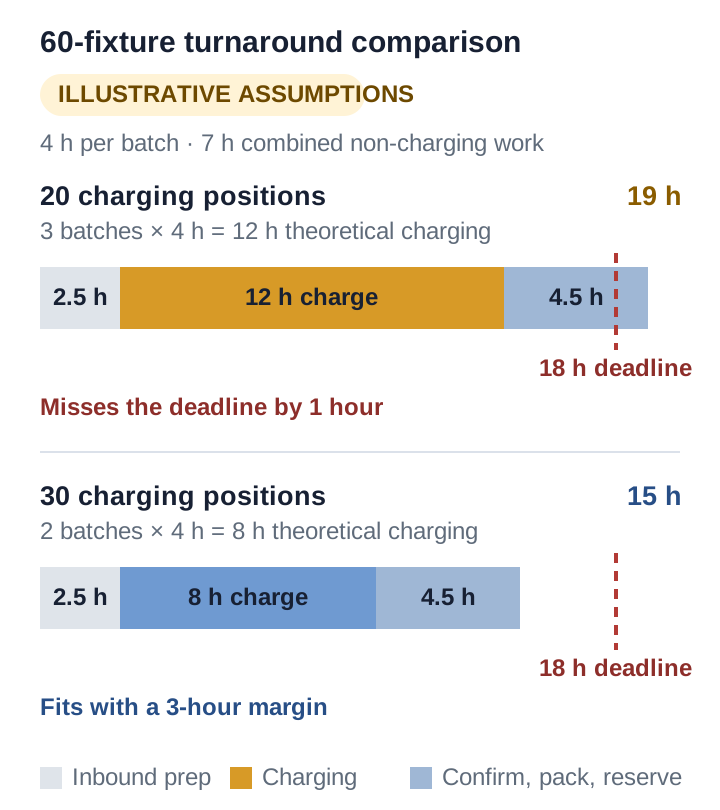
Illustrative assumptions only — not a LumiUp product specification or performance commitment.
Assume 60 fixtures require a full charge and the verified batch charge time is four hours. Use these workflow allowances:
- unload and count: 0.75 hour;
- cool-down/condition time: 0.5 hour;
- inspect and stage: 1.25 hours;
- full-charge and function confirmation: 1 hour;
- packing and dispatch preparation: 1.5 hours;
- operational reserve: 2 hours.
With 20 charging positions:
- charging batches = round up (60 ÷ 20) = 3 batches;
- theoretical minimum charging time = 3 × 4 = 12 hours;
- conservative committed turnaround = 0.75 + 0.5 + 1.25 + 12 + 1 + 1.5 + 2 = 19 hours.
With 30 charging positions:
- charging batches = round up (60 ÷ 30) = 2 batches;
- theoretical minimum charging time = 2 × 4 = 8 hours;
- conservative committed turnaround = 0.75 + 0.5 + 1.25 + 8 + 1 + 1.5 + 2 = 15 hours.
If the warehouse-to-dispatch gap is 18 hours, the 20-position plan misses the conservative commitment while the 30-position plan fits with a three-hour margin. That conclusion remains conditional on the electrical system supporting 30 simultaneous positions and on the four-hour batch test being valid for the exact configuration.
Data to Request Before You Place the Order
Ask the supplier to attach the answers to the quotation or approved technical file for each SKU:
- Exact fixture, battery, charger, dock and case model numbers.
- Charging time from a defined starting state to the documented full-charge indication.
- Battery age, ambient temperature, fixture state and test method used for that time.
- Number of fixtures or packs allowed to charge simultaneously.
- Maximum input current or power for one position and a fully occupied case.
- Destination plug, input voltage/frequency, protection, inrush and power-link limits.
- Charging-status indicators and how staff confirm completion or detect a failed position.
- Permission and conditions for charging inside the flight case, including lid and ventilation rules.
- Temperature, moisture, condensation and acclimation limits before charging.
- Whether the charger, dock, case, power leads and spare packs are included in the quoted line items.
- Spare-battery and replacement-charger availability, lead time and warranty treatment.
- Battery replacement route, cycle-test method and criteria for removing a weak pack from service.
- Runtime evidence for the actual scene, brightness and control mode you plan to use.
- Manuals and electrical declarations for the destination market.
Frequently Asked Questions
How do I calculate how many battery uplights can be ready overnight?
Count the fixtures that require charging, divide by the approved simultaneous charging positions and round up. Multiply that batch count by the verified charge time. Then add unloading, condition time, inspection, completion checks, packing and a reserve. Compare the result with the time from warehouse arrival to the next dispatch.
Is a three-hour charge time enough for back-to-back events?
Only if the complete return batch can access enough approved charging positions and the remaining workflow fits before dispatch. Sixty fixtures charging through 10 positions require six batches, not one. A single-fixture time does not remove that queue.
Can every position in a charging flight case run at once?
Do not assume so. Request written confirmation for the exact case and fixture configuration, including maximum input load, simultaneous-use permission, ventilation, lid position and charging indication.
Can battery uplights charge inside a closed flight case?
Only when the manufacturer’s instructions explicitly allow that configuration. Charging generates heat, and case ventilation differs. If the documentation does not state the lid and ventilation conditions, mark them as to be confirmed.
Does a removable battery make turnaround instant?
It can make a prepared fixture available sooner, but the pack still needs inspection, charging, tracking and service reserve. Turnaround shifts from a fixture queue to a pack-inventory and charger-capacity problem.
Does a drop-in dock charge faster than a cable?
Not necessarily. A dock changes the physical connection. Charge speed depends on the battery and approved charging system. Use a dock-specific measured time rather than assuming a speed advantage.
Should I compare advertised maximum runtime with full-output runtime?
No. Compare results from the same output mode, brightness, color channels, battery condition, temperature and end-of-test definition. A maximum runtime that depends on intensity is not directly comparable with an all-channel full-output result.
Plan the Fleet Before You Request the Quote
Send LumiUp the fixture quantity, events per day, available hours between warehouse return and the next dispatch, site or warehouse power, destination market and preferred control method. Include the expected scene or brightness, indoor/outdoor conditions and whether you want integrated batteries, prepared spare packs, drop-in docks or charging cases.
LumiUp can then recommend a model-specific fixture, spare-battery and charging configuration for review. The quotation should identify every included accessory and every item that remains optional.